

Fruit Stack Fall Screenshots
Who Should Play
Players start with small, basic fruits and gradually upgrade their size and variety through continuous pairing and merging. After multiple rounds of merging and advancement, they ultimately merge the fruits into their largest form—a plump watermelon—achieving the game's ultimate victory condition and unlocking the "Watermelon Achievement" reward.
How to Play
Basic Rules
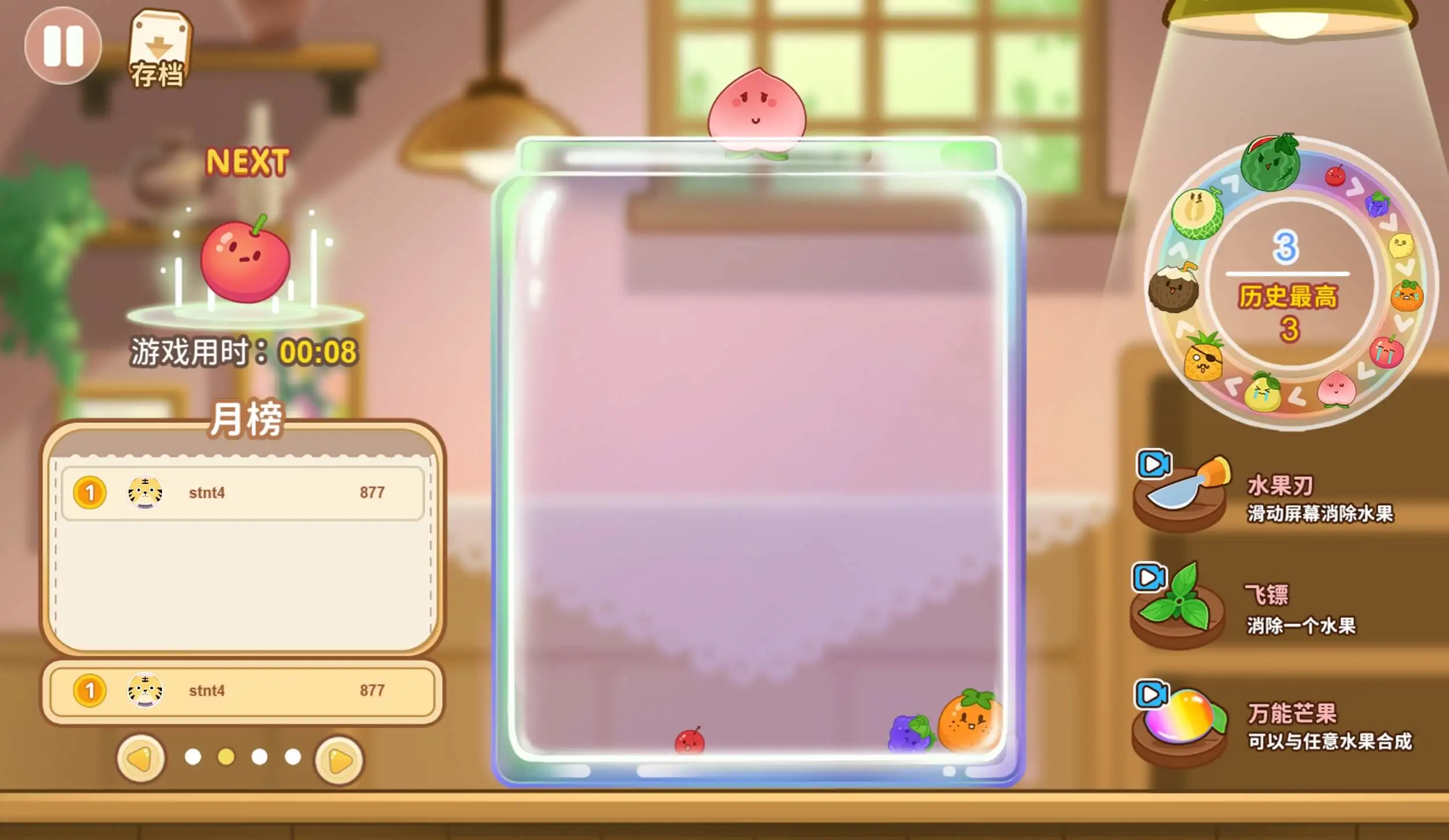
- Initial Setup Rules Fruit Tier Classification: In-game fruits are categorized into multiple tiers based on volume, starting from the smallest tier (e.g., cherries, blueberries) and progressively upgrading to strawberries, grapes, oranges, lemons, kiwis, pineapples, watermelons, etc. Watermelon represents the highest-tier fruit and cannot be further merged.
- Core Gameplay Mechanics Fruit Placement Control: During gameplay, new fruits fall at a constant speed from directly above the platform or random horizontal positions. Players control the horizontal movement direction by dragging with the mouse (or swiping on touchscreens). Before fruits contact the platform, players must release them at the optimal position to complete placement.
- Fruit Synthesis Rules Basic Merge Logic: Merge only occurs when two fruits of identical tiers collide directly and maintain stable contact. Upon Merge, the original fruits disappear and generate a single fruit one tier higher (e.g., 2 cherries merge into 1 strawberry; 2 strawberries merge into 1 grape; and so on).
Game Controls
Click the mouse to drop fruit
Frequently Asked Questions
Prioritize placing fruits near platform edges or existing stable stacks to use boundaries and stacked fruits as barriers. Slow down your movement when placing fruits to let them drop vertically, minimizing rolling deviations caused by lateral collisions.
Prioritize merging lower-tier fruits (like cherries or strawberries) that appear in larger quantities on platforms, avoiding scattered placement of the same type. Monitor upcoming fruit types and pre-position adjacent fruits of the same type to trigger instant synthesis.
Are there any tips to speed up synthesis? Currently, fruits fall at a fixed pace. However, you can accelerate the process by creating “chain syntheses”—for example, triggering an initial synthesis with newly dropped fruits, then having the resulting high-tier fruits collide with surrounding fruits of the same type. This secondary synthesis significantly saves time.
Do they affect stacking strategies? A: Lower-tier fruits (like cherries and blueberries) are small and roll easily, making them ideal for concentrated stacking. Higher-tier fruits (like pineapples and watermelons) are large and stable, serving as “foundations” placed at the bottom of platforms to support smaller fruits above, reducing the risk of the entire stack collapsing.